


Czech Students Hold Strong in Digital Skills
Czech Students Hold Strong in Digital Skills
Under the auspices of the Czech Ministry of Education, Youth and Sports, the Ministry of Labour and Social Affairs, the Ministry of Industry and Trade, and the Digital Czechia initiative, the fourth edition of the IT Fitness Test took place in Czechia.
As the largest comprehensive assessment of digital skills in Central Europe, the initiative continues to scale. In 2025, more than 63,000 pupils, students, and teachers participated in Czechia alone, contributing to a total of nearly 163,000 participants across the V4 region.
“We are pleased to build on the success of previous years and once again assess a significant number of Czech pupils, students, and teachers. Initiatives like this help ensure that digital skills receive the attention they deserve. The rapid development of artificial intelligence will continue to raise the bar for the digital competencies required both in the labour market and in everyday life,” says Jaromír Hanzal, Director of AAVIT.
Strong results, yet significant gaps remain
The results show that Czech students perform well overall in digital skills. At the same time, they highlight persistent disparities across different groups. Grammar school students achieved the highest average success rate at 62%, while students from vocational schools reached only 41%. This 21-percentage-point gap reflects a structural challenge that is also visible when comparing multi-year grammar schools with primary education. Regional data confirms long-term trends: Prague ranks among the top performers, while the Ústí nad Labem Region remains at the lower end of the scale.
“In terms of digital skills, we remain well above the EU average. The IT Fitness Test is one of the initiatives that contributes to this – it motivates, inspires, and provides valuable insights. It is an excellent initiative, and we are pleased to support it annually as part of Digital Czechia Week,” says Martin Charvát.
Practical skills lag behind everyday digital use
Czech pupils and students perform best in areas related to information search and navigating the online environment. However, weaker results appear in the use of office tools – particularly when working with spreadsheets and more complex data.
The findings suggest that while students are often able to reach the correct outcome, they frequently lack a deeper understanding of underlying principles and data relationships. This underlines the need to strengthen the practical teaching of digital skills.
“The IT Fitness Test confirms that digital competencies are now a core part of education. Students are strong in what they use daily – search, communication, online environments – but lag behind in office tools, collaboration, and data work. Yet these are exactly the skills that will determine their success in the labour market,” says Nicole Benedicty.
AI is entering the classroom, but critical thinking remains key
The test also showed that some participants are already using AI tools. However, the results confirm that without critical thinking and contextual understanding, AI alone is not sufficient.
A new addition to this year’s edition – the IT Master Test for advanced users – highlighted a similar pattern. While top-performing students successfully tackled tasks requiring algorithmic thinking, many struggled when faced with unfamiliar scenarios.
Celebrating top performers
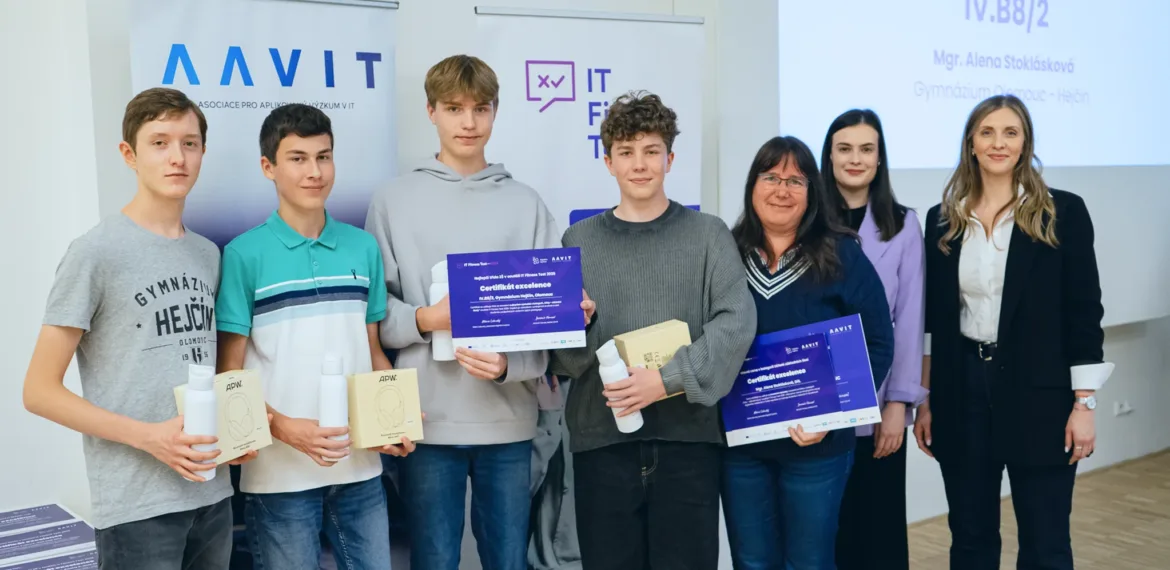
The fourth edition culminated in an awards ceremony held at Impact Hub Praha.
A total of 43 students, teachers, classes, and schools were recognised for their outstanding performance. Alongside certificates, winners received valuable prizes from project partners – highlighting the importance of collaboration between schools, the public sector, and technology companies.
At ESET, we see education as the most effective defence against cyber threats. Our partnership in the IT Fitness Test allows us to measure digital skills based on data – not assumptions – and target support where it is most needed. Modern technologies, including AI, bring enormous opportunities but also new risks. That is why not only technical but also security literacy is essential,” says Vítězslav Pelc.
About the initiative
The Czech edition of the IT Fitness Test is organised by AAVIT.
The initiative is held under the auspices of the Ministry of Education, Youth and Sports, the Ministry of Labour and Social Affairs, the Ministry of Industry and Trade, and the Digital Czechia.
Partners in Czechia include ESET Czech republic, Česko.Digital, Alza, ÁMOS Vision, and EDU-AI. The media partner is Czech News Center, and the event partner is Impact Hub Praha.